Trails #1: "The Siren Shack"
A tale about two creatures stranded on the wrong side of the water.

Trails Volume 1: Kindling — Story #1
Genre(s): Coastal/Southern Gothic Fantasy.
Synopsis: A young man trapped in a hurricane-flooded Gulf town dives into dark water to rescue a stranger and surfaces to find she isn’t human. What follows is a negotiation between two creatures stranded where they don’t belong: the siren who can’t find her way home, and the boy who’s been trying to leave his whole life. They strike a bargain—her passage for his—and discover that the thing they each needed most wasn’t a door, but someone willing to make the crossing with them.
Content Warnings: This story contains suicide ideation, near-drowning, themes of entrapment and isolation, and hopelessness. Please take care of yourself as you read.
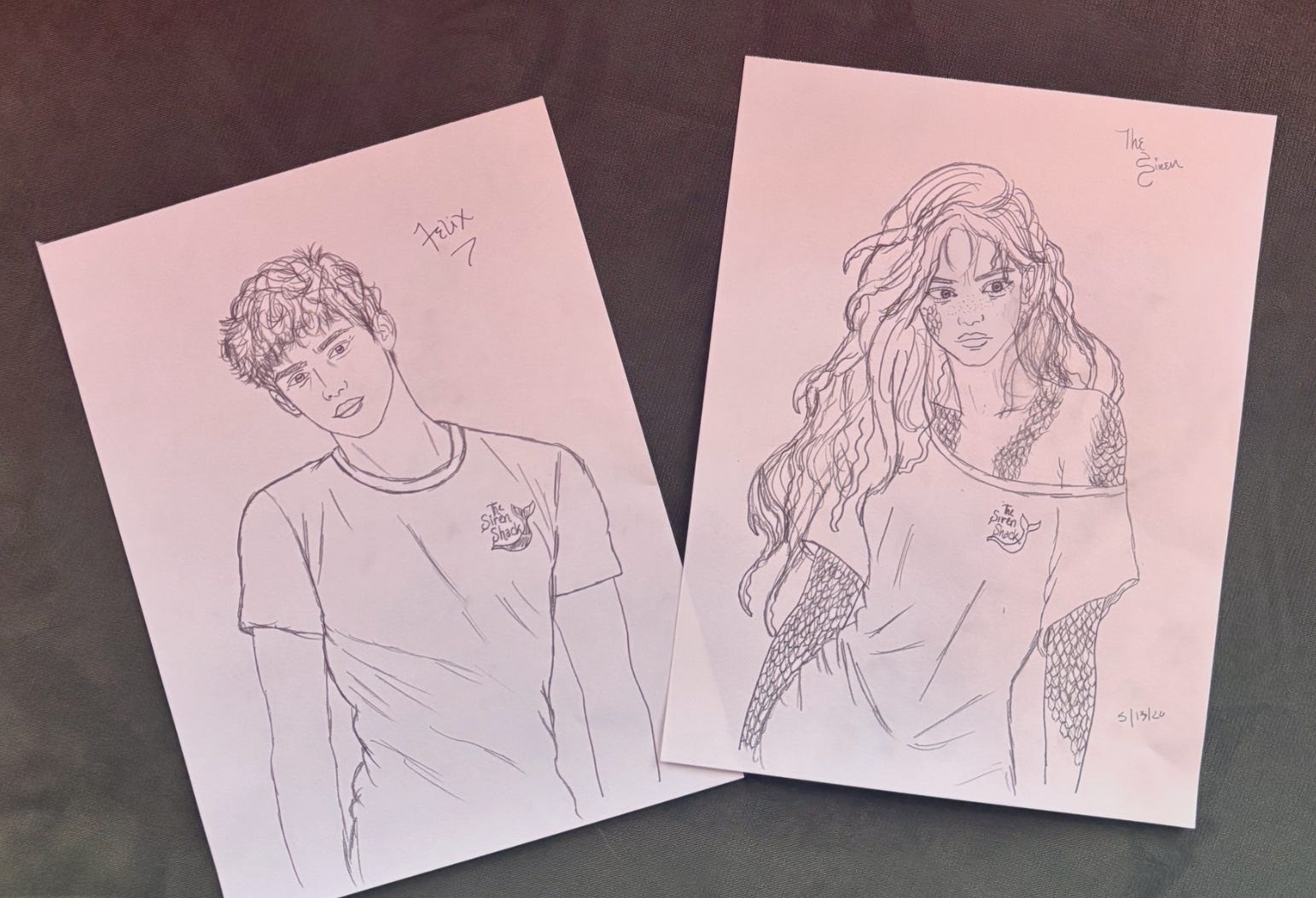
Imagery: The sketches were done by me. All the images were sourced from Unsplash—a great resource for free, non-AI-generated stock photos.
THE SIREN SHACK
This town, uninspired as it was, left its captors with only two fates: die or flee. The thing is, fleeing was as much a fairy tale as the mermaids were.
Looked like drowning was my only option.
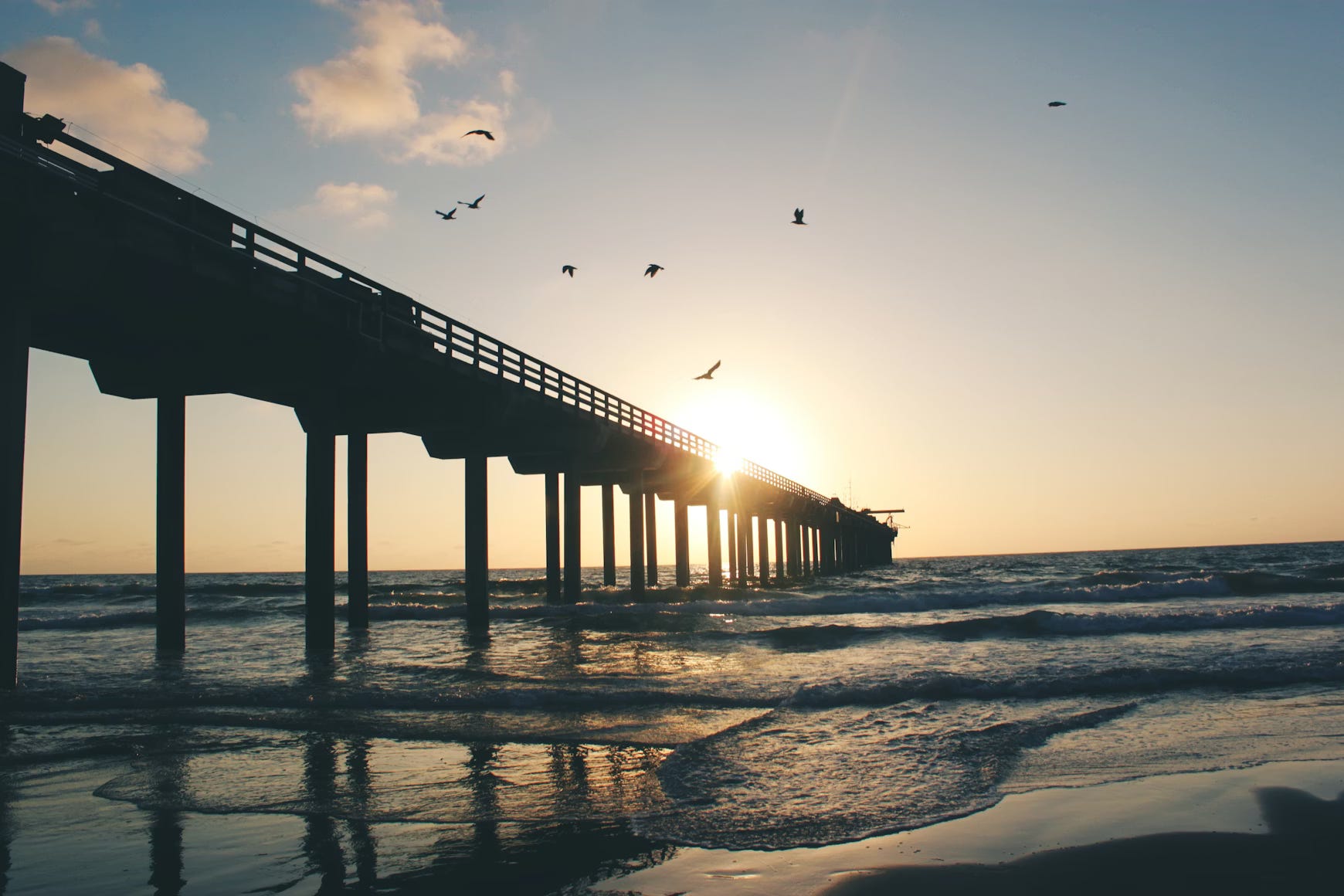
The town didn’t have a name worth remembering. It was a smear of salt-warped wood and bait shops pressed against the Gulf like something the ocean coughed up. We had one stoplight, two groceries, three churches, and a restaurant called The Siren Shack that was decorated with plastic mermaids the color of chewed up bubble gum.
I had worked every station that shack had to offer. Line cook, waiter, busboy, oyster shucker—once, memorably, the emcee for a six-year-old’s birthday party where I wore a foam crab suit. I had given four years of my life to the shack. I had saved every dollar that didn’t go toward keeping the lights on at my parents’ place, and I had a deposit down on a dorm room two states away and a start date for classes circled on my calendar.
I should have left a week sooner.
Hurricane Piper made landfall on a Thursday and when the water finally dropped, the only bridge out of this place had a twenty-foot gap in it like a row of missing teeth. The coast guard had bigger problems than fixing our rinky dink bridge. We were low priority and everyone seemed to know that except me.
“Felix!”
Marisol’s voice cut through the dinner rush, sharp enough to crack crab shell. She was already nodding her head toward the far corner booth. A new table. I tucked my notepad into my apron and made my way over, trying and failing to walk in a straight line.
I was born crooked. Scoliosis. In a town this small, everyone knew me as the crooked one. I was ready to be known as something else. Someone else.
I let the shift carry me the rest of the way, table to table, refill to refill.
Every day the bridge sat broken was a day closer to losing my deposit. The college had a policy, and I’d read it sixteen times now, the paragraph highlighted in yellow on a printout folded in my glovebox.
Students who fail to appear in person by the deadline forfeit non-refundable fees and their placement.
I couldn’t afford that. I couldn’t afford a lot of things.
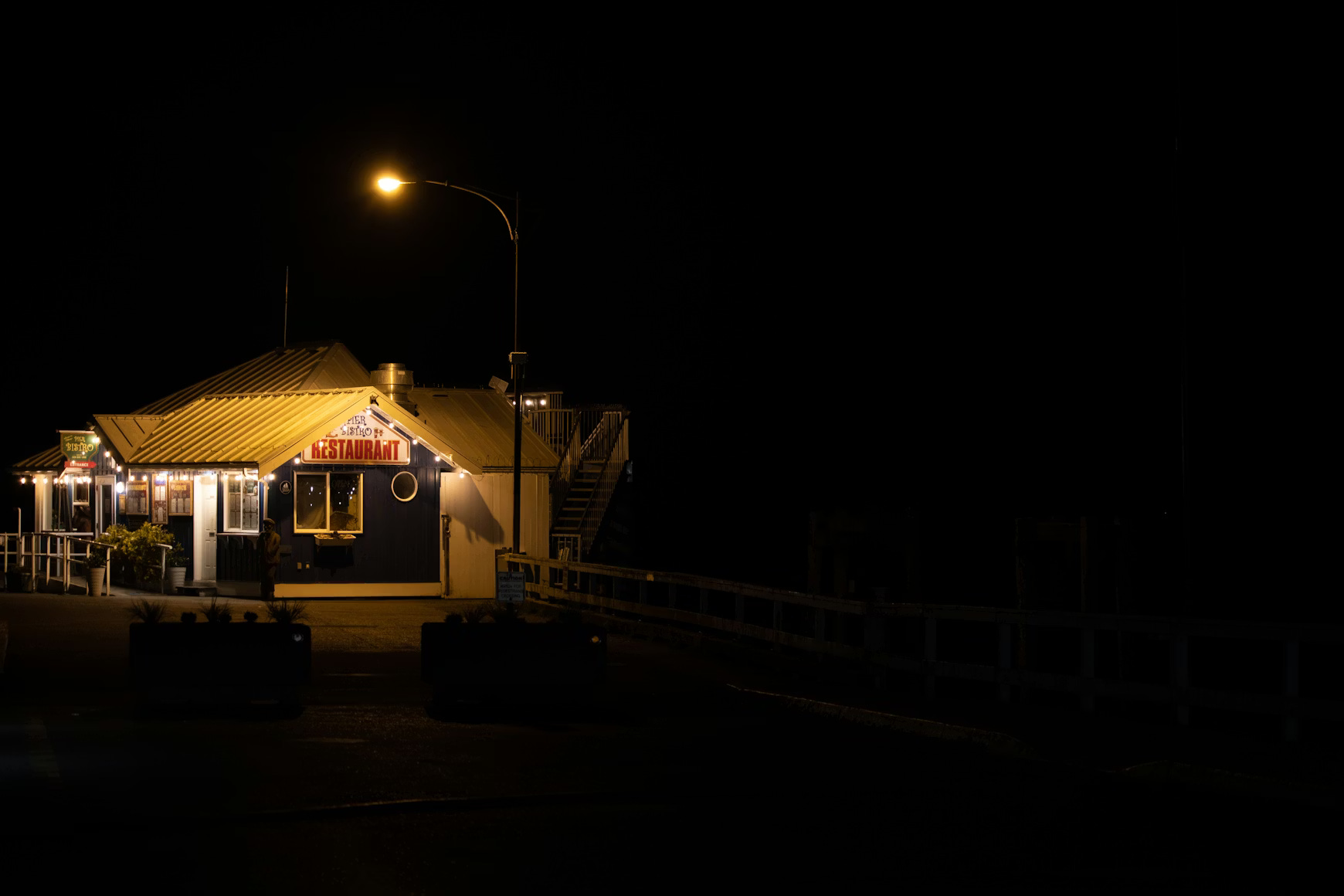
I sat in the parking lot until the lights buzzed on and the last busboy locked up and drove away. Then I sat there a little longer, listening to the ocean push, pull, push, pull.
I started walking. Out of the lot, onto the docks, then the pier. I didn’t stop until I ran out of planks beneath my feet and my chest met the wooden rail separating me from the water.
I leaned over the edge and breathed in. Salt and brine, the same flavor that had baked into my skin so deep I wasn’t sure where the town ended and I began. I used to wonder what it would be like to smell something else—sugar or rain or fresh-cut grass. The water below was gray. The sky above was gray. Both clouded with the same haze that always settled over this place.
I didn’t want to go home. Home was my parents in their recliners, the television loud with opinions about a world neither of them had seen much of. The air thick with cigarette smoke and the specific staleness of people who had stopped trying to live.
I hung my head against the rail and let the wood take some of my weight.
Maybe I could swim across the space between the bridge and the mainland. It’d be a long swim. The rocky shores made the shallow water turbulent, the tide more vertical than horizontal. I could slip into a tidepool and drown before I got halfway across the gap.
The idea of drowning didn’t sting as much as the possibility of being stuck here.
I patted the damp rail, shifted my weight off the bad leg, and turned to go—
A piercing, frantic cry stopped me mid-whirl.
I spun back toward the water. The docks stretched out in both directions, empty, shadowed. The water lapped against the pilings.
It came again. Higher this time, splitting the air open. I turned toward it, my steps unsteady, scanning the water and the neighboring docks for machinery or an animal—
By the third wail I found her.
A girl. Tangled in netting near the end of the adjacent dock, thrashing. She screamed again—piercing and desperate and all throat—then she went under.
I was moving before she was fully out of sight.
I sprinted across the lot, hit the wrong dock first, corrected myself, found the right one. The boards groaned under each footfall. I was already digging the oyster knife out of my shorts, already not thinking about the water or the cold or the tide. I reached the end of the dock, went over the rail, and dove in.
The water hit like a slap. I surfaced once, got my bearings, and went back under. Seaweed dragged across my forearms and calves. The salt found every small cut I didn’t know I had.
I kicked toward where she’d gone under.
The netting had pulled her down, snarled around something structural. A pylon or rusted anchor line, I didn’t know. The dock light above only reached so far, but I could see her by the way she moved, the churn of her arms fighting, her mouth opening in a breathy scream.
I grabbed her shoulder and she went rigid.
I couldn’t speak between the water smacking my face, so I said it with my hand as best I could. One firm press. I’ve got you. Stop fighting.
She stilled, nodded, then I dove under.
My hands were clumsy with cold, fingers going numb at the tips, and the current kept nudging me sideways. I hooked my arm around the nearest rope and pulled myself in close and started cutting.
The netting was swollen with salt, knotted in layers. I sawed through one line and felt the tension shift but not release. There was more. I surfaced for air and went back down. Something moved against my legs while I worked. Several somethings—fish, caught the same as she was, wriggling against my shins and knees.
The tide was the real problem. Every few seconds it would drag me back a foot and I’d have to burn the effort to close it again. My legs didn’t fail me. In water, I didn’t have a bad one.
I cut through the last line and felt her come free.
We went up together, her arm in my grip, breaking the surface into the distant smell of the Siren Shack. She gasped beside me, a huge tearing sound, and I did the same. Then we were swimming.
Or she was swimming, and I was keeping up with her, which shouldn’t have been possible given the tide and the cold. But free of the rope, she moved through the water like a fish. I watched her out of the corner of my eye between breaths and told myself it was adrenaline or the current shifting.
She hit the shore before I did. I dragged myself onto the concrete ramp at the edge of the lot, rolled onto my back, and coughed until the ocean gave back what it had taken. The adrenaline left my body and my nervous system began its report of my crimes. Sore muscles, bruising, scrapes. That would be tomorrow’s problem.
I turned to check on the girl. The lot lights caught her first.
Silver.
I’d thought it was the water or the fluorescents. I thought it was salt and sand in my eyes.
It wasn’t.
Her arms were scaled from wrist to shoulder, disappearing beneath hair that was pink and fleshy and tendrilled, slow-moving even without wind, like the trailing arms of a jellyfish. Scales lined her cheekbones, crossed her collarbone, her chest. And below her hips, where legs should have been—
What the fuck.
A fish tail.
It shifted against the concrete. Wide as my shoulders. Translucent at the fin’s edge.
My mind flashed to the moment I could have made a different choice. The pier. The rail. The moment before the dive.
Maybe I didn’t make it.
Maybe the tide took me, and the rescue and the swimming and the whole ugly slog didn’t really happen. Maybe I drowned and this was whatever came next—which meant I died in this parking lot, under these lights, in this town, and still didn’t get to leave.
This was hell. And I didn’t think I deserved hell.
I almost laughed, but I didn’t get the chance. She twisted and her tail came around in a broad arc and caught me clean across the side of the head.
The lot lights went out.
***

I woke to the taste of salt and blood. My limbs cold to the bone, my chest burning where rope had bitten through the fabric of my shirt.
I twisted where I sat and felt the rope fibers bite deeper into my ribs. My fingers were numb. I blinked, felt grit rake across my eyes, and closed them again. I needed to get my bearings.
The ground beneath me was soft and soaked. Every few seconds the tide would reach me and retreat. Faint above me, the low whoosh of a car on the coast road. Not far. That was something.
I opened my eyes again and took the sting until my eyes teared up and washed some of the sand out.
Darkness, mostly. Pale strips of dock light filtered through the planks overhead. I was under one of the piers, tied to a pylon that was uncomfortably close to the waterline—the waterline that was now a few inches closer than it had been a moment ago.
I tested the rope. Nothing.
Then I saw her.
The girl from the water was standing a few feet away, on two legs now, wearing a soaked Siren Shack t-shirt. It hung heavy off her thin frame, drooping from one shoulder, skimming her upper thighs. Below the hem: legs. Or the rough draft of them. Scaled silver all the way down to webbed toes.
I caught a glimpse of a nametag peeking through her pink hair.
Felix.
I looked down at myself. My shirt was gone. She took it.
“The hell?” I said, before I could think better of it.
She put her hands on her hips and squinted at me. The dock light caught her eyes for just a second—wide yellow irises, the pupils blown and ovular, tracking nothing like a human eye would.
Goddamn fish eyes.
“What the fuck are you?” I wheezed.
Her mouth fell open, which only compounded the fish impression, and she let out a frustrated shriek before kicking a spray of wet sand into my face.
“Hey!” I caught a second kick. “Cut it out!”
“What the fuck are you?” She fired back. Her words came out strange—technically correct, but the cadence was wrong, like she didn’t quite understand what they meant but knew they were offensive when she threw them back at me.
“I’m normal,” I said, and almost laughed at myself. In this town, that word had never applied to me. But here, tied to a pylon with fish girl staring me down, I’d take it.
“You don’t look normal to me.” Her head tilted. “Bent boy.”
The words landed dead center in my pride. I was aware, suddenly and painfully, of the way I sat: the tilt of my shoulders, the jut of bone, the S of my spine, crooked against the pylon.
“Right back at you, fish girl.”
Her scales flashed, a full-body shimmer, and she lunged—only to collapse teeth-first and close enough to my ankles that I yanked them hard to my chest to avoid losing a foot.
She surfaced from the sand furious, shoved to her knees, and tried to stand again.
“Useless!” She slapped the water with both palms, scales flickering with her temper. Then she grabbed a pylon for purchase and hauled herself upright—held it for exactly as long as it took for a small wave to brush the backs of her calves—and sat back down.
I watched her, and stupidly, felt a pang of sympathy. For a body that wouldn’t do what it was meant to do, that wouldn’t obey its host.
“What’s wrong with you?” I heard myself ask.
She looked up. The yellow dimmed in her eyes, the pupils pulling into something rounder, and for just a moment she looked human enough that it softened everything else. The scales, the tendrils.
“What’s wrong with you?” she countered. More curious than cruel.
“Touché,” I sighed.
The tide moved in. I felt the water climb my chest and swallowed a surge of panic. “Look, are you going to eat me or not?” I asked.
She wrinkled her nose. “You don’t look very delicious.”
The water kissed my collarbone. “Great. Then untie me.”
“You cut my net.”
I stared at her. “You’re welcome?”
She dragged her fingers through the wet sand, and the sharpness went out of her. “I was trying to get home.”
“By…drowning?”
“It would have returned me to where I came from.” She said, voice going distant. “I can’t find the way back.” Her eyes dropped to her legs, and something moved across her face that tugged those loose sympathy threads I was feeling for her. “I’ve been here too long.”
My mouth fell open. “You were trying to die?”
She looked up at me, and I braced for teeth, for sand in my face. Instead, she looked like she was about to cry.
I leaned my head back against the pylon and couldn’t help but feel the same urge.
The dorm room deposit. The highlighted paragraph folded in my glovebox. The way I’d stood at the pier rail with my weight pressed forward, like the ocean might have an answer I hadn’t thought to ask for yet.
“I think,” I said, almost to myself, “I understand.”
The tide pushed in. Water reached my neck.
“You are trying to get home too?” she asked, head tilting. “To the other bent boys?”
I laughed and immediately swallowed a mouthful of saltwater. I spat it out and shook my head, coughing. “No. No, I was trying to go somewhere new. Somewhere better.”
“And drowning would take you there?”
My chest squeezed at the simplicity of it. “It would have taken me somewhere.”
She went quiet. The water moved between us, and I watched her look at me the way I’d been looking at her, both of us trying to figure out who and what the other one was.
“Well, you cut the thing that would take me home,” she said.
I considered telling her there are many ways to drown, but I didn’t want to give her any ideas. I didn’t want to give her that way out, and I wasn’t sure why it mattered to me at all then.
The tide came in again and this time it lapped my chin, and I had to tilt my face toward the dock beams to keep my mouth clear.
She stood suddenly, and this time she made it—arms out, adjusting her weight foot to webbed foot—and walked toward me unevenly, like crossing a deck in rough water. She crouched at the pylon behind me, then I heard and felt the rope shift.
I exhaled as the rough rope loosened and dropped to the water then quickly scrambled away from the tide. I crawled until my torso was above water, then my legs, before I flopped onto the packed sand. Bits of seashell and seaweed bit into my back, but I was too grateful to be gulping down air.
Grateful to not have drowned. To be alive.
A shadow crossed over me, and when I opened my eyes, I found the girl—her eyes again becoming less fish-like, her hair still and less jellyfishy. In the darkness, away from the glare of the lot lights, she looked almost normal. Her corded pink hair could have been braids, her ovular irises, swallowing much of the color just dark eyes. The shine of her skin glitter or makeup.
Something about it made me…sad. Like the dream, nightmarish as it was, was fading and I’d have to go back to my car and then home and then my life.
“What now?” I asked her.
She tilted her head, studying me. “I would like to go somewhere else.”
“Yeah,” I huffed, pushing myself onto my elbows. “That makes two of us.”
She didn’t reply, only looked at me and waited as if I had all the answers..
“Where did you come from?” I asked. “Is there another way back? Another…” I gestured vaguely toward the water. “Door?”
Her eyes flicked to the tide. “There are many doors.”
“Great,” I said. “Where are they?”
“I don’t know,” she admitted. “I used to, but now…”
“You’ve been here too long,” I finished for her.
She nodded.
Silence settled between us again. The tide whispered in and out, brushing the edges of where we sat.
Then she stepped closer, and I tensed.
“When I held onto you,” she said, “I was stronger. Faster.”
I frowned. “What?”
“In the water,” she clarified. “When you cut the net. I could feel more. The currents. The pull of things. It was easier to move.”
“That’s adrenaline,” I said. “Or panic.”
She shook her head. “It was you.”
I opened my mouth to argue, then closed it. “Okay,” I said slowly. “Let’s say it was. What does that mean?”
She stepped close enough now that I could see the detail of the scales along her collarbone.
“I think you have something I need.”
I let out a short breath but couldn’t grasp a reply.
“Could I borrow it?”
“Borrow what?”
“Your…energy.” She frowned at the word like it didn’t quite fit. “So, I can find my way home.”
I stared at her.
“I don’t—” I laughed, a little sharper this time. “I don’t have extra of anything, okay? I can barely get myself out of this place.”
She didn’t move or argue. She just watched me.
“Look,” I said, dragging a hand down my face. “Even if I wanted to help, I wouldn’t know how.”
She tilted her head again. “What if we shared?”
I frowned at her and waited.
The tide rolled in, then out. The sound filled the space between us for a few breaths.
“Tell you what,” I said, lighter now, almost joking. “You get me across that busted bridge, I’ll lend you whatever you think I’ve got.”
Her eyes sparkled.
“You want to cross over,” she said, a tremble of excitement in her voice.
“Yeah,” I said.
She looked past me, over the shore and through the dark lot, as though she could see the broken bridge from here.
“I can do that.”
I blinked. “You can?”
“Yes.”
A beat.
“Okay,” I said. “Then we have a deal.”
She shook her head. “A bond.”
Something in the way she said it made my stomach drop, like there were layers to the word I wasn’t seeing and should before I took another step down this path. “…What does that mean?”
She stepped even closer. Too close.
Up close, the last of her inhuman edges were fading. The scales along her shoulders dimmed, smoothing into skin. The strange tension in her posture eased. Even her eyes—those wide, wrong eyes—shifted. The pupils narrowing, rounding, the irises ambering, becoming something I could almost recognize.
Human.
Beautiful, even.
I should have looked away.
“This is how we share,” she said, softer now, eyes on my mouth.
I knew I should’ve stepped back but I found myself leaning closer. She was suddenly the other side of the bridge and I would do anything, agree to anything to be on the other side with her.
“And after?” I heard myself say.
“You help me find my door,” she said. “And I help you cross.”
It sounded simple. Too simple. But then again, so did drowning, and I’d been standing at a pier rail with my weight tipped forward not that long ago. Sharing energy, bonding or whatever she called it, seemed better.
She reached for me. Slow and careful, giving me time to pull away.
But I didn’t. I wouldn’t.
Her fingers brushed my wrist first. Cold, but soft. Careful, but affectionate.
Something shifted under my skin at the contact—a flicker, like a current finding a path—and all at once I was aware of everything: the sand caked into my hair, the rope burn across my ribs, the salt drying in the creases of my palms. And then the awareness narrowed and there was only her.
My breath hitched.
She rose on her toes and breathed into me, “Let us bond then.”
For half a second, I thought about the bridge. The dorm. The highlighted paragraph in my glovebox. The life I’d been building toward, dollar by dollar, that was supposed to be waiting somewhere past all of this.
Then I stopped thinking and met her halfway.
Her lips were cold and salty, then sweet. The flavor spread—caramel and sea salt and something underneath that was nameless—and I kissed her back before I’d decided to, my hands finding the front of her shirt and pulling her in. She came without resistance, her cold palms pressing flat against my jaw, and the sweetness kept spreading, moving outward from my mouth like warmth returning to a numb hand.
For a stretch of time, there was only the salt and the sweetness and the cold and the feel of her in my arms, and the peace of a person who has finally stopped fighting the current, letting it take them where it intended.
Something surged between us—a snap, a pull, a lock clicking open—and my chest seized.
The world tilted. Shifted. Opened.
She pulled back.
For a second, neither of us moved, then she smiled and all the inhuman parts of her rushed back in.
She took my hand. “Come, bent boy.”
Before I could ask anything else, she pulled me forward—
—and dove.
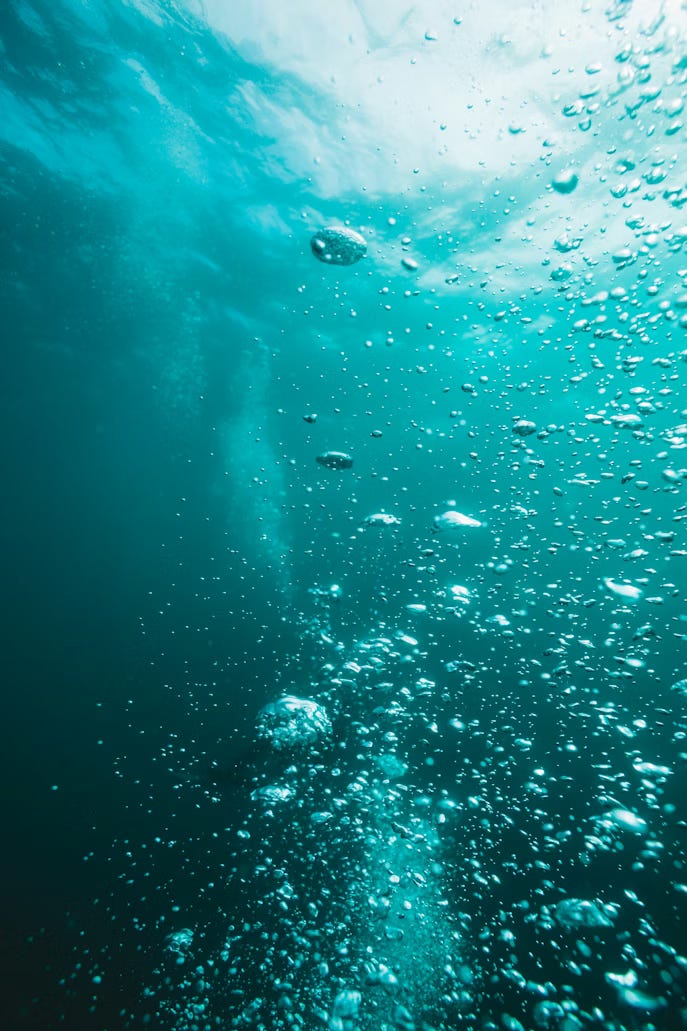
The water swallowed us whole.
I thrashed, instinct taking over, lungs locking, body screaming to get back to the surface, but her hand tightened around mine.
And something…changed.
I opened my eyes.
Shapes moved around us—currents, I realized, but not just water. Something layered inside it. Paths. Threads of gold. Pulls I could suddenly feel as clearly as my own heartbeat.
Doors.
My legs kicked to keep up with her, suddenly strong and even. No imbalance. No bad side.
I laughed, or tried to, but it came out as a rush of bubbles.
We dove deeper. The threads flashed brighter. Her skin shone silver. Then, so did mine.
The salt in my mouth turned sweet. Not sugar-sweet. Something crisper. Brighter. Like air after rain, or the smell of somewhere I’d never been but had been reaching toward my whole life.
I drank it in and squeezed her hand.
She squeezed back.
And for one impossible, perfect moment, I didn’t want to leave.
I woke up choking. Air slammed into my lungs, and I jerked upright with both hands pressed to my chest, wheezing until my ribs ached.
Water sloshed at my ankles. I smelled the sea and the stale cherry air freshener in my car—
I was in my car.
I froze and looked through the windshield.
It was early morning. The street lights were still on, throwing orange-yellow cones of light across the asphalt. Everything inside was soaked—the seats, the dash, the steering wheel—dripping like the whole thing had just been hauled up from the bottom of the Gulf.
My shirt clung to me, soaked. I pressed a hand flat against my sternum and felt my pulse—
My nametag was gone.
The ocean flashed behind my eyes: the girl, the currents, the threads, the way my spine gave into its shape and I wound through the tide like a snake.
Then it slipped, the way dreams do when you try to remember them.
I twisted in my seat.
The bridge loomed behind me. Still broken, the concrete ending in mid-air.
“…How?”
Help me find the door. I’ll help you cross.
My hands shook as I turned the key. The engine groaned, coughed, then failed. I tried again. It sputtered.
On the third try, it caught.
A startled laugh that also could have been a scream burst out of me.
I threw the gear into drive and floored it.
The town fell away behind me, slow at first and then faster, the road opening up. I rolled the window down and the air rushed in. Salt and brine, strong at first, then it started to thin, slowly replaced with the stench of ozone and wet grass. I breathed it in over and over, trying to mark the exact moment it stopped tasting like the town and started tasting like somewhere else.
I extended one hand through the open window, fingers slicing through the wind with glee—
Something flashed along the back of it.
Silver.
There then gone.
I yanked my hand back in the car and laid it atop the steering wheel for a better look.
My stomach pitched as I watched a single silver scale slip beneath my skin.
I stared at my hand until my eyes blurred. It looked like my hand. Felt like mine. Whatever had surfaced had vanished before I could grasp it, slipping away as quickly as the dream. I didn’t know if that meant nothing or everything or something I wasn’t equipped yet to understand.
She’d said I had something she needed. I wondered if she’d left something in return.
I shook out my hand, let out a slow breath, and rolled the window up.
Then I kept driving and never looked back.